

From spec to sale, writing a used car advert buyers will read
How to write a used car advert from a confirmed stock record: what buyers scan first, the details that build trust, and a six-step routine to check it.
In this post
A good used car advert gives buyers the facts they need without making them work for them. It puts key details up front, describes the car honestly and makes it easy to understand what is included.
For a busy forecourt, the challenge is doing that consistently for every vehicle. Start with a confirmed stock record, not a blank page, and the advert becomes easier to write, and easier to check.
What buyers scan first
Most buyers are comparing several cars at once. Make the essentials easy to find:
- Price: Show the total price clearly, including any compulsory charges.
- Mileage: State the current reading accurately. If its accuracy is uncertain or there is a discrepancy, explain what you know rather than relying on a vague disclaimer.
- History: Summarise the available service records and any relevant vehicle history.
- Photos: Use clear images of the actual vehicle. Include the exterior, interior, dashboard, boot and any marks a buyer should know about.
A useful opening line identifies the vehicle rather than trying to sell it with a string of adjectives. For example: “2019 Ford Focus Titanium, 1.0 petrol, manual, 62,410 miles.” Add the price where the listing format allows it to sit clearly alongside the headline.
Details that make an advert trustworthy
Specific information helps a buyer decide whether the car suits them, and whether it is worth arranging a viewing. It also gives you a clear record of what was represented.
Name the exact trim and fitted equipment. Separate standard features from optional extras, and include only equipment you have checked is present. A precise list is more useful than a broad claim such as “high spec”.
Describe the service history as it is. “Full service history” should match the documents or digital records available. If you have invoices for some services but not a complete record, say so. Where possible, note the date and mileage of the most recent documented service.
Be clear about condition. “Clean for its age” is subjective. Describe marks a buyer can see, and disclose known faults clearly. For example: “Light kerb marks to the nearside alloy and a small scratch on the rear bumper; both are shown in the photos.” Only use this wording if it accurately describes the car.
Say what comes with it. Mention relevant items such as the number of keys, handbook, charging cable or spare wheel. If something a buyer might expect is missing, make that clear.
Include relevant history and checks. Note the MOT expiry and any relevant advisories, and disclose material information you know about the vehicle’s past use or history. The Business Companion guidance for car traders explains that important information should be accurate, clear and provided in time for a buyer to make an informed decision. The ASA’s advice on advertising ex-fleet vehicles also explains why a vehicle’s former business use may need to be stated.
From confirmed spec to finished advert
A repeatable process helps whether you sell a few dozen cars at a time or turn stock over quickly. The aim is simple: enter and check information once, then use it to prepare consistent advert copy.
Start with the stock record. Add the vehicle and use the registration lookup as a starting point for details such as make, model, year and trim. Treat returned information as a prompt to check, not proof that every detail is correct.
Confirm the specification. Compare the record with the vehicle, its documents and the information available to you. Check the derivative, fuel, gearbox, mileage and fitted equipment. Correct anything that is wrong or incomplete before drafting.
Add history and condition notes. Record the documents you hold, recent work, known marks, relevant checks and anything that needs to be disclosed. Keep fact and assumption separate: if a detail is unverified, do not turn it into a definite claim.
Take the photographs. Photograph the actual car in good light and include enough views to give a fair impression. Add close-ups of notable marks. If a photograph no longer reflects the vehicle’s condition, replace it.
Prepare the advert from those confirmed details. Use a clear order: headline and price, key facts, equipment, history, condition, what is included, then viewing information. Keep paragraphs short. Put useful facts ahead of generic sales language.
Check it before it goes live. Compare every claim with the stock record and supporting information. Confirm the photos match the car, the price is correct, and important details are easy to see. Edit or remove anything you cannot substantiate.
AI can draft; you remain in control
Writing every advert from scratch takes time, especially when the same details need to be described clearly across a full stock list. AI-assisted drafting can give you a first version based on information already confirmed in the vehicle record.
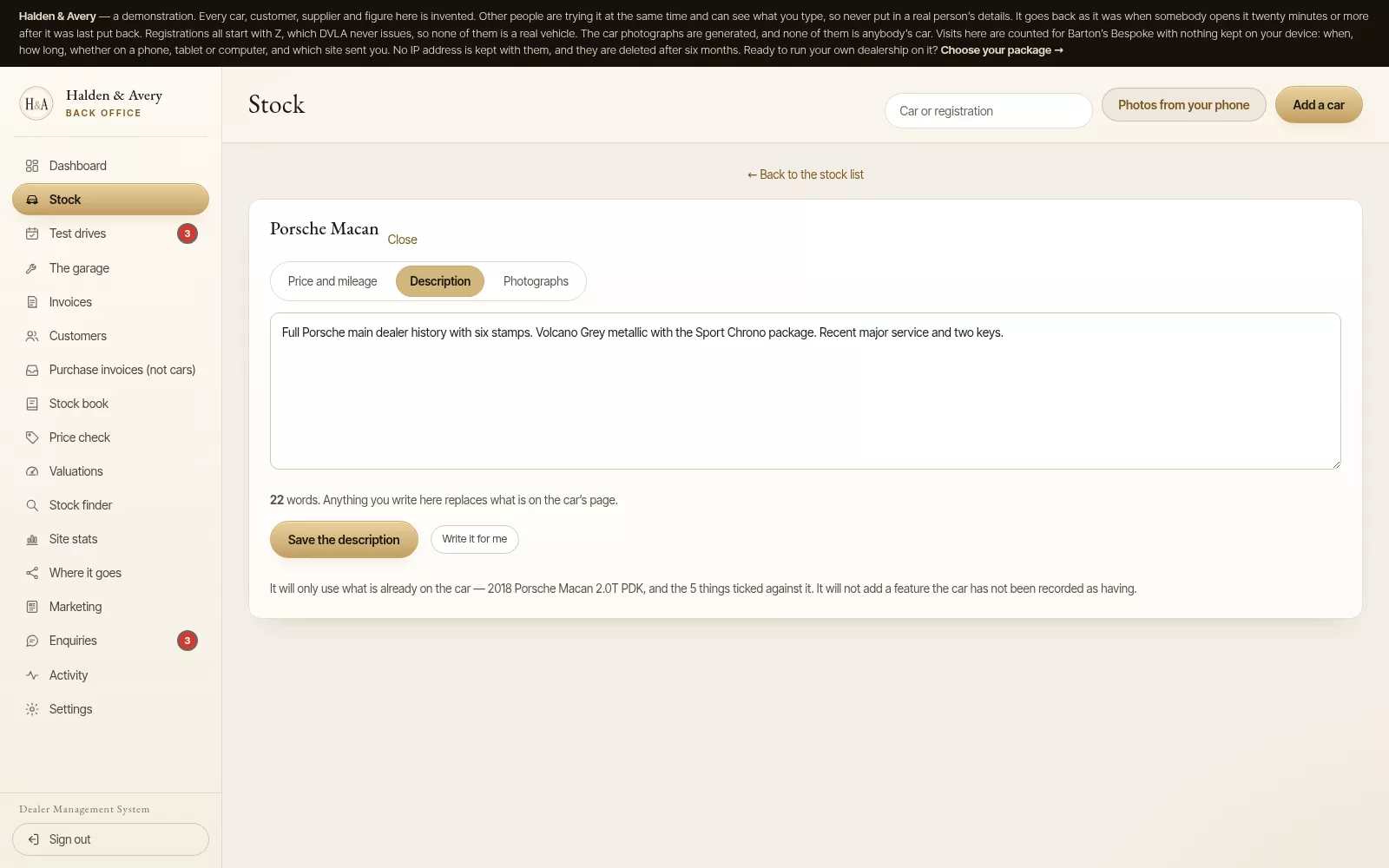
In Barton's Bespoke, Write it for me drafts the advert from what is already recorded on the car: its trim, colour, engine, gearbox, mileage and the equipment and history you have ticked. It adds nothing you have not recorded. The words land in the description box for you to change, and nothing reaches the car’s page until you press Save the description.
That distinction matters. A draft can help organise information and save you starting with an empty page, but it cannot replace checking the car, its documents or the claims in the advert. Human review stays part of the process.
Keep the content connected to the car
When advert writing begins in a separate document or from a saved template, it is easy to miss an update or repeat work. A connected stock record gives you a more reliable starting point: the vehicle details are recorded once, then used to prepare its advert for your website and other places you choose to list it.
That is practical for a small team sharing sales and administration, as well as for a higher-turnover forecourt where consistent descriptions are important. It does not remove the need to check each vehicle. It makes the routine work more orderly.
If you are reviewing how your current process works, take a look at the Barton's Bespoke dealer management system. You can explore the information and decide whether a stock-record-led workflow would suit your dealership.
The pictures in this guide are illustrations, except where a caption says otherwise.