

Plan the ramp week before it plans you
Read the workshop diary as a capacity plan: where jobs overrun, how to protect space on each ramp, and a 15-minute Monday review for an independent garage.
In this post
A full diary is not always a workable diary. Plan around the ramps, people and jobs you have, and leave room for the work that never arrives neatly scheduled.
For an independent garage, the week can start with a sensible list of bookings and still become difficult by Tuesday. A job takes longer than expected. An MOT queue meets a busy service day. One technician is off sick, and the work assigned to them has nowhere obvious to go.
The answer is not simply to squeeze more appointments into the diary. It is to use the ramp diary to see where capacity is committed, where it is tight and where you still have room to respond.
This is a different task from filling a quiet spell with extra demand. Once bookings are coming in, the priority is to protect a plan the team can deliver.
Why the week drifts
A diary can look open while the workshop is already at capacity. A vehicle may be booked in for the day, but that does not mean a ramp and the right technician are available for every part of the job. Nor does a free-looking hour account for a delayed part, an inspection that finds extra work or a vehicle that needs moving before the next job can start.
Common pressure points include:
- Jobs that overrun. A problem takes longer to diagnose, or an inspection leads to work that needs customer approval.
- Different queues sharing the same space. MOTs and services may need different ramps, equipment or staff. A gap in one queue does not necessarily make room in the other.
- A diary booked to the edges. With no gaps, even a small delay can push work into the next job.
- A change in staffing. When a technician is away, the plan may need to change, not just the jobs assigned to that person, but the work that depends on their skills.
None of these makes a plan pointless. They make it important to keep the plan visible and review it before pressure arrives.

Read the diary as a capacity plan
Start by looking beyond the number of bookings. Read the diary by ramp or work area, and consider which technician is available for each job. If your garage has a dedicated MOT ramp, for example, check that queue separately from general servicing and repair work.
Look for signs of pressure:
- Two jobs appear to need the same ramp or specialist equipment at overlapping times.
- A day has no space between jobs for vehicle movements, checks or work that runs late.
- Several uncertain jobs are grouped together, with no clear point to review progress.
- A technician’s day depends on a job finishing exactly when expected.
- Tomorrow’s diary assumes that every vehicle in today’s plan will be finished and collected.
A calendar showing only vehicle drop-off times can hide these clashes. The useful question is: what resource does this job need, and when will that resource be free again?
If a job needs further diagnosis or customer approval before the repair can be confirmed, keep that uncertainty visible. Don’t let an unapproved repair quietly become a firm commitment to a ramp and a finish time.
Build the plan one ramp at a time
Work through each ramp’s availability before treating the whole workshop as open. For each job, consider the likely work involved, who can carry it out and whether parts or specialist equipment are needed. Use your own experience of similar jobs to plan the time, and adjust when a vehicle’s condition or the work required is uncertain.
Then leave space, and plan it in.
That space is not wasted capacity. It gives you options when a job runs over, an urgent issue comes in or a quick task needs fitting in. You might protect a short slot for simple work that can be completed without disrupting a longer repair. Or you may keep a gap available on a particular ramp because it is the only one suitable for a certain job.
The right balance will depend on your workshop. Make protected capacity visible in the diary, rather than assuming you will somehow find it later.
An illustrative example:
| Ramp or queue | Planned work | Capacity to protect |
|---|---|---|
| MOT ramp | Confirmed MOT bookings | Space for a change or follow-up work |
| General ramp A | A service and a known repair | A gap before the next committed job |
| General ramp B | A longer, less certain repair | A check-in point before adding more work |
This is only an example, not a recommended allocation. Your ramps, team and job mix will determine what is realistic. The aim is to see each commitment in context, rather than filling every line because a slot looks available.

A 15-minute Monday diary review
A short weekly review can expose conflicts while there is still time to adjust. Keep it practical: the goal is not to predict every problem, but to spot where the plan has no room to absorb one.
- Check who is available. Confirm technician attendance and note any changes that affect particular jobs or equipment.
- Review each ramp and queue. Look at MOT bookings separately from services and repairs. Check that jobs are assigned to suitable space.
- Mark the tight spots. Identify days with overlapping needs, no gaps or several uncertain jobs close together.
- Check carry-over work. Confirm what is unfinished, what is waiting for approval or parts, and whether it still belongs in the week’s plan.
- Protect some flexibility. Keep appropriate space for quick jobs, overruns or urgent work. Make clear which slots are held back and why.
- Choose what to change. If the plan depends on everything going perfectly, move or review a commitment before the workshop is under pressure.
The routine can be simple. What matters is that the diary reflects the work you have agreed to do, and the capacity you still need to run the day.
Make online bookings answer to the diary
A customer-facing booking website can help prevent avoidable clashes, provided it uses the workshop’s actual availability. It should not offer a time simply because a date looks free on a general calendar.
When website availability is drawn from the ramp diary, and MOT and service bookings are handled in separate queues, customers are shown options that better reflect what the workshop can take on. Availability should also be checked again when a booking is submitted. If a slot has been taken in the meantime, the customer can be asked to choose another instead of creating a double booking.
Not every job can be booked neatly online. A brief description may not explain a warning light, an intermittent fault or what a previous repair involved. Those requests still need a person to clarify the work and decide where it fits. The diary can support that decision; it does not have to make it for you.
The online booking is the front end. The ramp plan remains the working tool.
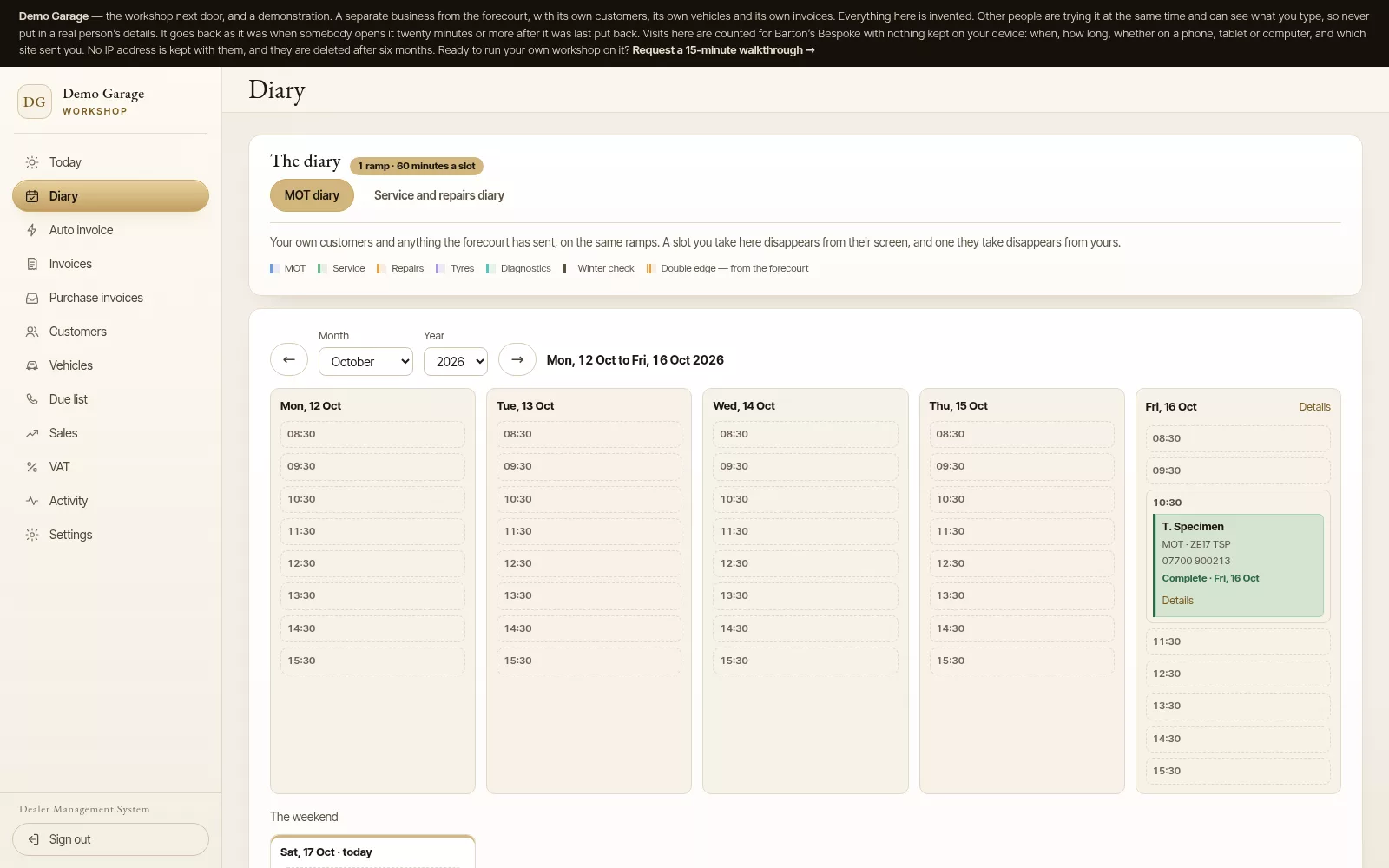
Keep control when the plan changes
Even a well-planned week will change. When a job runs over, update the diary and look at what it affects next. Is the next booking tied to the same ramp? Can the work move to another suitable space? Does the customer need an update before a promised time becomes difficult to meet?
Make the next action clear. A job waiting for a part, a customer decision or more diagnosis should not look the same as work that is ready to begin. That distinction helps the team see what can move forward and what needs attention first.
A ramp diary is most useful when it shows both commitments and constraints. It lets you make a conscious choice: keep a protected slot, move a job, check a diagnosis or contact a customer. It does not remove your judgement. It gives that judgement a clearer picture to work from.
Plan a week you can deliver
A workshop booking system should help you see what each ramp can take, keep MOT and service availability distinct, and reduce the need to untangle conflicting bookings. But the working habit matters too: review the diary, protect room for change and update it as the job progresses.
If you want to see how a connected workshop diary and customer booking website can work, take a look at Barton's Bespoke garage management software or view the workshop demonstration. You can explore the setup and decide whether it fits your garage.
The pictures in this guide are illustrations, except where a caption says otherwise.